North Korea Crisis: Russia’s Putin Warns of ‘Global Catastrophe’ by F. BRINLEY BRUTON and ALAN KAYTUKOV
MOSCOW — Russian President Vladimir Putin warned Tuesday that ramping up the "military hysteria" around North Korea's escalating nuclear and missile tests could lead to a "global catastrophe."
He also questioned the effectiveness of tightening sanctions, as the U.S. has suggested, saying that they will not change the behavior of Kim Jong Un and his regime.
North Korea "would rather eat grass" than abandon its nuclear program "as long as they do not feel safe," Putin said.
The Russian leader urged dialogue with Pyongyang.
"In this situation, pressing on military hysteria will not bring anything. This may end up in a global catastrophe and huge amount of human life lost," Putin told reporters during a visit to China.
His comments came two days after Kim's government detonated its sixth and largest nuclear test.
On Monday, South Korea responded by firing missiles into the sea to simulate an attack on the North with more military drills being held on Tuesday. President Donald Trump later tweeted that he had given the go-ahead for Japan and South Korea to buy a "substantially increased amount" of sophisticated military equipment from the U.S.
Putin also suggested that Kim's government had learned lessons from the U.S. invasion of Iraq that toppled Saddam Hussein, pointing out that after that dictator "abandoned weapons of mass destruction, everyone remembers how he ended up. North Korea remembers this too."
North Korea has said in public statements that it wants an official end to the Korean War. The conflict was halted by a 1953 armistice but no peace treaty has been signed. It also says it wants nothing short of full normalization of relations with the U.S. and to be treated with respect and as an equal in the global arena.
China has warned North Korea against launching another ballistic missile, saying it should not worsen tensions.
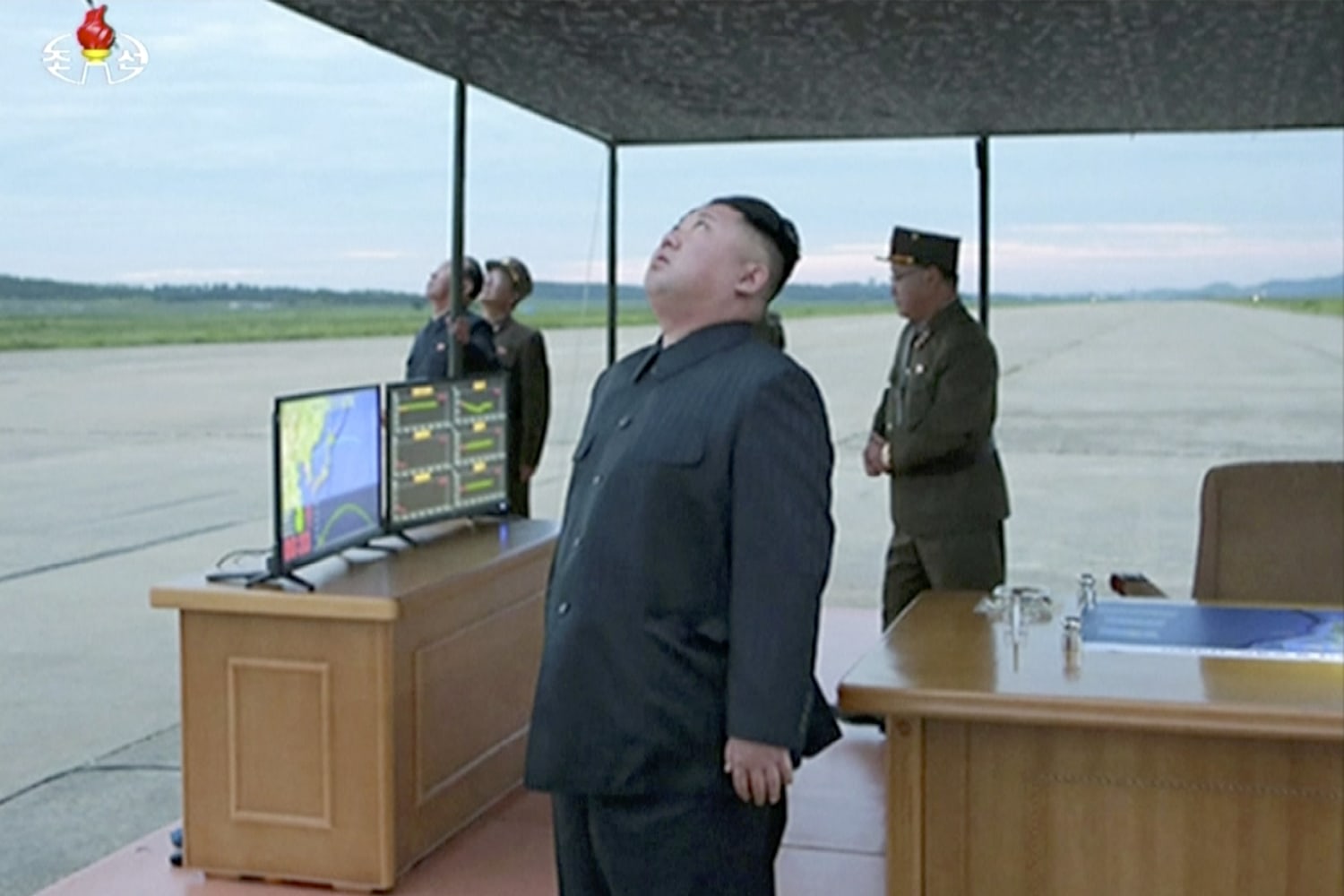
On Monday, the U.S. urged the United Nations to step up pressure on Kim and accused him of "begging for war."
Nikki Haley, U.S. Ambassador to the U.N., said: "Enough is enough ... we must adopt the strongest possible measures." She added: "We have kicked the can down the road long enough. There is no more road left."
On Sunday, Trump tweeted that he was considering stopping all trade with any country doing business with the secretive regime.
North Korea imports or exports from more than 100 nations. However, around 90 percent of Pyongyang's trade is with Beijing and Trump has often said the Chinese should take more steps to rein in Kim's nuclear ambitions.
Experts told NBC News that Trump's suggestion would strip consumer goods from the shelves of American stores, jeopardize hundreds of thousands of U.S. jobs and spark a meltdown across the global economy.
Taylor Griffin, a former Treasury spokesman and White House staffer under President George W. Bush, warned that such a policy would result in a "very painful lesson in economics" for Americans.
He added: "There would be ripple effects everywhere. People talk about a butterfly flapping its wings and causing a tornado on the other side of the world. This wouldn't be a butterfly — it would be a 747 taking off."
Kim has been very open about his regime's ambitions. North Korea regularly issues apocalyptic warnings to the U.S. and its allies.
Last month, the regime’s official Rodong Sinmun newspaper said the U.S. would be "catapulted into an unimaginable sea of fire" if it imposed more sanctions or threatened military action. In May, the paper said the North was "waiting for the moment it will reduce the whole of the U.S. mainland to ruins" after Trump dispatched a naval strike group to the region.
Such threats have been a staple of Kim's regime since he took power after his father's death in 2011.
In October, Lee Yong Pil, a top North Korean official, told NBC News that "a preemptive nuclear strike is not something the U.S. has a monopoly on." He added: "If we see that the U.S. would do it to us, we would do it first."
Sources: NBC news
Comments
Post a Comment